



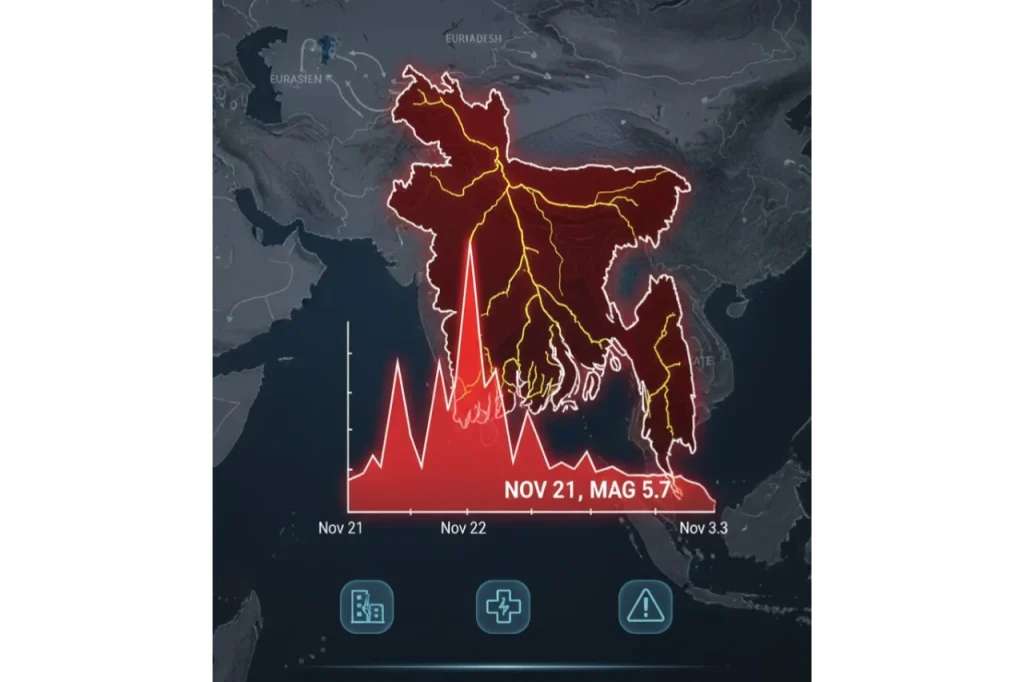
Two earthquake tremors were felt in Bangladesh in the last 24 hours, which is seen as a warning of the instability of the country’s tectonics. The first earthquake was a strong 5.5 to 5.7 magnitude—killing at least 10 people and injuring hundreds more. The second was relatively mild, a magnitude 3.3, but it caused renewed public concern. Experts are warning that Bangladesh may face another major earthquake at any time. According to the Bangladesh Meteorological Department (BMD) and the US Geological Survey (USGS) data, the first earthquake struck on November 21 at 10:38 am. Its epicenter was in Madhabdi upazila of Narsingdi, just 25-40 km from Dhaka. The tremor lasted 26 seconds and the depth was only 10 km. As a result, the walls and roofs of buildings shook in different parts of the country including Dhaka, Narsingdi, and Narayanganj. According to preliminary information, at least 10 people were killed in the incident—5 in Narsingdi, 4 in Dhaka (the railing of the building fell in the German Mosque area), and 1 in Narayanganj. The number of injured is over 600, including Dhaka University students and factory workers in Gazipur. The damage included injuries to pedestrians from brick-cement falling from the incomplete building, collapsed scaffolding, and damage to some temporary structures. Tremors were also felt in neighboring West Bengal, India, though no major damage was reported. A second earthquake struck just 28 hours later, at 10:36 a.m. on November 22. Its magnitude was 3.3 on the Richter scale and the epicenter was in the Bypile area of Savar. It was relatively mild, so no deaths or injuries were reported. But tremors were felt in Dhaka and surrounding areas, fueling popular concern after the first incident. Why are earthquakes happening in Bangladesh?
Bangladesh is a geo-naturally very vulnerable region. The country lies on the border of India, Eurasian, and Burmese tectonic plates, where the India plate is subducting under the Eurasian plate. As a result of this unrest, the North and the eastern region are prone to earthquakes, while the central region is relatively stable. Rubaiya Kabir, head of BMD’s earthquake observatory, said the region has historically experienced frequent large earthquakes and a stronger (magnitude 7.0) tremor could strike at any time, although timing is impossible. According to seismologist Syed Humayun Akhter, there was an 8.0 magnitude earthquake in the country in 1918 and a 5.6 magnitude near Rangamati in 2003. Since 1950, 14 earthquakes of magnitude 5.5 or greater have occurred within 250 km of Dhaka. In the last decade (2015-2025), the country experienced 20 earthquakes, the strongest of which was Ramganj in Lakshmipur in 2023 with a magnitude of 5.5. Experts say major earthquakes happen every 150 years, so the Dhaka-centric region could turn into ‘Mrityupuri’ if no preparations are made. Government authorities and the Disaster Management Department (DMDP) have urged people to remain vigilant. Fire services and civil defense are carrying out rescue operations. The BMD said further tremors are likely, so temporary shelters and emergency services have been kept active. Experts are suggesting that it is important to use earthquake-resistant design in building construction and increase public awareness.