



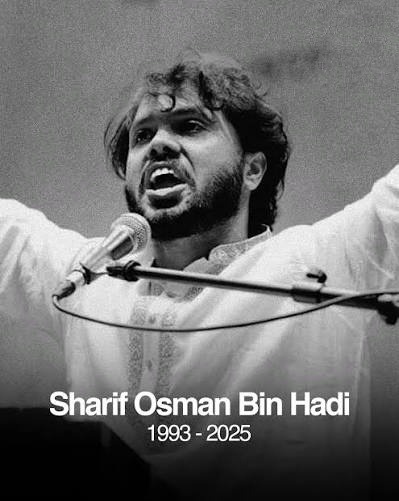
In Bangladesh’s recent political history, the name Sharif Osman Hadi is no longer just an identity—it has become a symbol, a question, and the center of an explosion.
After his death, the nation’s streets, campuses, social media, and politics are dominated by one question—
“Why did Hadi die?”
Sharif Osman Hadi: Who was he?
Sharif Osman Hadi was a top organizer and spokesperson of the National Citizen Party (NCP). Despite his young age, he quickly gained a reputation politically for his outspokenness, strong criticism of the state structure, and uncompromising stance.
He was active on the streets during the 2024 Mass Movement and later became a symbol of alternative political thought among the youth. He presented himself not as a representative of any conventional power, but as “the voice of the man on the street”.
In his speeches, he used to come up again and again—
- Question of the electoral system
- Accountability of power
- Role of security forces
- Freedom of expression
This is why he was as popular as he was controversial
Murder: What Happened?
On the night of December 12, Sharif Osman Hadi was shot at while returning from a political program in a busy area of Dhaka. According to eyewitnesses, the attackers were well organized and moved quickly after the incident.
He was taken to the hospital with serious injuries. He died under treatment on the night of December 18 after battling death for a few days. It is this death that changes the situation.
Why is this death not just a death?
Sharif Osman Hadi’s death did not strike the general public as a personal assassination. It has been seen—
- As an attack on political dissent
- As an attempt to suppress young leadership
- As an ominous message for future politics
A large section of the youth, in particular, believed Hadi was killed because he was spiraling out of control.
State response and controversy
The government declared a day of national mourning and promised an investigation. However, the transparency of the investigation has been questioned since the beginningOpposition political parties and civic platforms demand—
Behind these killings is not only “unknown terrorists”, but a larger political context.
A gap between the official narrative and the reality on the ground is created, making the situation even more heated.
Why did protests spread across the country?
As the news of Hadi’s death spread—
- Protests started in different cities including Dhaka, Chittagong, and Rajshahi
- Students skip classes
- Road blockades, marches, and clashes ensued
The main demands of the protesters were—
“Public trial by identifying the killers”
At one stage of these protests, violence erupted, further complicating the situation.
Media, Social Media, and Divided Reality
Controversy also arose over the role of the media in Hadi’s death. Many complain that some media have ignored or fragmented the issue.
On the other hand, Hadi became a kind of “martyr symbol” on social media. His words, videos, and old posts started going viral again.
This divisive presentation also fueled anger.
- More truths are coming out
- Hadi had repeatedly reported security threats before his death
- He took a public stand against several state decisions
- He became a source of discomfort for both political allies and opponents
Although these issues are now part of the investigation, the crisis of public confidence has not abated.
One death, many questions
Sharif Osman Hadi’s death is not just the end of a political activist. This is a bare reflection of the current political reality of Bangladesh.
Today, people are not only mourning—
They are asking,
afraid of
And worried about the future.
If the trial of this death is not transparent, then Hadi may be another name in history—
whose death changed the politics of a country, but the truth was never fully revealed.