



File Photo: Reuters
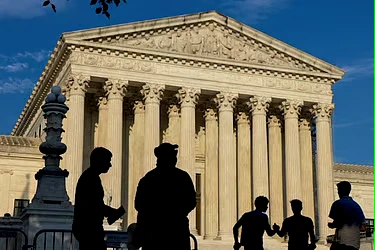
The Supreme Court has agreed to review the validity of President Donald Trump’s executive order tightening the provision of birthright citizenship in the United States. Yesterday (December 6), the court agreed.
Trump issued the executive order as a step to strengthen immigration in the United States. It also conflicts with the 14th Amendment of the US Constitution.
Donald Trump took office as the US President last January. On his first day in office, he signed an executive order banning birthright citizenship to children of couples living in the United States illegally. However, a series of lower court rulings in the United States blocked that decision. Now Supreme Court judges have accepted the US Department of Justice’s appeal against the lower court’s ruling.
Trump’s order stated that if the parents of a child are not United States Citizens or legal permanent residents (Green Card holders), the country’s agencies will not recognize the child’s U.S. citizenship.
But the lower court ruled that Trump’s policy violated both the 14th Amendment to the US Constitution and federal law protecting birthright citizenship. The lawsuit was filed in the Lower Court on behalf of people threatened with losing citizenship because of Trump’s policies.
No date has yet been set for arguments in the Supreme Court in the case challenging Birthright Citizenship. It may take months for the case to be processed.
The legal challenge came shortly after Trump issued an executive order to deny birthright citizenship to the children of illegal immigrants. At that time some Judges of the Federal Court ruled that it violated the Constitution. At the same time, two Federal Circuit Courts of Appeal upheld the stay on the execution of the order.
14th Amendment of the United States Constitution. Under it, for nearly 160 years, the principle has been established that anyone born in the country is considered a citizen of the United States. But this policy is different only in the case of children of diplomats and Foreign Military Forces.
Trump’s Executive Order states that people living in the United States illegally or on temporary visas do not grant citizenship to children born in that country. This is part of the Trump Administration’s broader effort to reform the country’s immigration system. The Trump Administration says the initiative is aimed at addressing significant threats to national security and public safety.
The American Civil Liberties Union (ACLU) is representing the plaintiff in the case. Its National Legal Director Cecilia Wang told the BBC’s US subsidiary CBS, that no President can change the basic promise of Citizenship through the 14th Amendment.
In a statement, Wang said, “For more than 150 years, everyone born on the territory of the United States has been considered a Birthright Citizen, according to our laws and National Heritage. We hope that the matter will be finally resolved in the Supreme Court this time.
The 14th Amendment to the US Constitution was enacted to grant citizenship to freed slaves and their children at the end of the Civil War. It did not apply to children of aliens who came to the United States temporarily or to children of illegal immigrants. The idea that citizenship can be obtained by being born on the soil of the United States is wrong.
D. John Sauer, Solicitor General of the United States
There are about 30 countries in the world that grant Birthright Citizenship to any child born within their borders. The United States is one such country.
The legal challenge came shortly after Trump issued an executive order to deny birthright citizenship to the children of illegal immigrants. At that time some Judges of the Federal Court ruled that it violated the Constitution. At the same time, two Federal Circuit Courts of Appeal upheld the stay on the execution of the order.
Trump then went to the Supreme Court against the stay. Last June, the Supreme Court ruled in its favor, and the stay granted by the lower courts exceeded their jurisdiction. However, the court did not comment on the main question of Birthright Citizenship.
The 14th Amendment was passed after the United States Civil War. This amendment was introduced to finally resolve the question of citizenship for former slaves born in the United States.
United States Solicitor General D. John Sauer said the Amendment was brought to grant citizenship to freed slaves and their children after the Civil War. The Amendment was not introduced for the children of aliens who came to the United States temporarily or the children of illegal immigrants. He said, the idea that citizenship can be obtained by being born on the soil of the United States is wrong.
A study published by the Migration Policy Institute and the Population Research Institute of Pennsylvania State University in May last year said that if Birthright Citizenship is canceled, the number of undocumented people in the United States could increase to 2.7 million by 2045 and 5.4 million by 2075.
A study published last May by the Migration Policy Institute and the Population Research Institute of Pennsylvania State University said that if Birthright Citizenship is canceled, the number of undocumented people in the United States will increase to 2.7 million by 2045, and 5 million by 20754 may increase.