



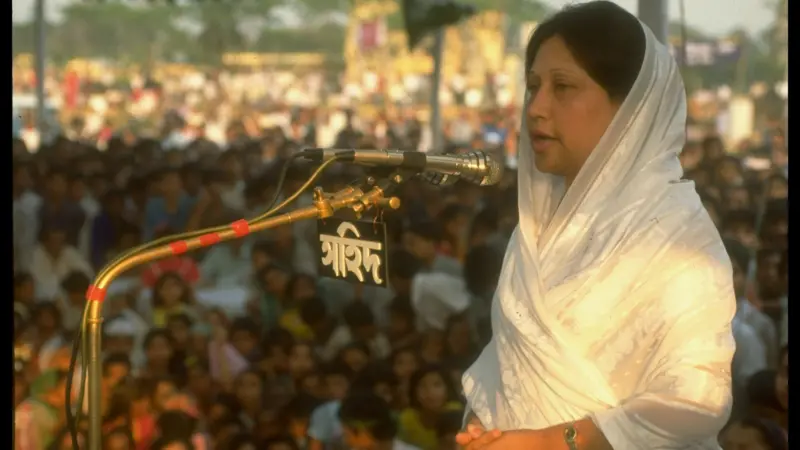
Khaleda Zia, the first woman prime minister in the history of Bangladesh, has passed away. He died at the age of 80 years in a hospital in Dhaka.
Khaleda Zia, one of the leading figures in Bangladesh politics for more than four decades, took the Bangladesh Nationalist Party (BNP) to power in just 10 years after stepping down from being a housewife to politics.
The parliamentary system of government was reintroduced in the country during the first term of the BNP led by Khaleda Zia.
Khaleda Zia took the reins of the party to sustain the beleaguered BNP in the wake of the assassination of BNP founder and president Ziaur Rahman in 1981.
According to analysts, Khaleda Zia took the BNP politically from within the circle of power. But there was also criticism of the close ties between the BNP led by him and various religious parties including Jamaat-e-Islami.
Dolls to Khaleda Zia
Khaleda Zia became a widow at the age of 36. She was an ordinary housewife then. Tarique Rahman and Arafat Rahman—his family consisted of these two children.
Her full name was Khaleda Khanam. He was nicknamed Putul by family members and relatives.
They got married in 1960 when Ziaur Rahman was a Captain in the Pakistan Army.
She took the name Khaleda Zia after marriage, according to her sister Selima Islam.
He became known by this name after becoming active in politics.
Selima Islam told BBC Bangla that Khaleda Zia did not care about politics at that time. Ziaur Rahman was not involved in any political activities even when he was president.
According to a section of critics, Ziaur Rahman inherited the leadership of BNP after his death.
Journalist Mahfuz Ullah published a book on the life story of Khaleda Zia. Widowed at a young age, Khaleda Zia built her position by virtue of leading a political party in a patriarchal society, she told BBC Bangla at the book launch.
He took the lead in the disaster of the party
After Ziaur Rahman’s death, BNP-An internal conflict begins. Many leaders then joined the military ruler General Hussain Muhammad Ershad.
Khaleda Zia joined BNP on 3 January 1983 during this crisis. First Vice Chairperson, later elected Chairperson on 10 May 1984.
BNP leader Major (Retd.) Oli Ahmed, who is close to the family, said that Khaleda Zia entered politics only after a request to sustain the existence of the party.
Khaleda Zia was born on 15 August 1946 in Jalpaiguri, then British India. His father is Iskandar Majumder, mother is Tayeba Majumder.
Their original residence was Phulgazi Upazila of Feni District, and later they settled in the Mudipara area of Dinajpur city.
Known as an uncompromising leader
When the BNP took over in 1982, the country was under military rule by General Ershad.
In 1983, Khaleda Zia joined the anti-Ershad movement by forming a seven-party alliance. On the other hand, an eight-party alliance was formed under the leadership of the Awami League.
The BNP came to power in the elections held on 27 February 1991 and Khaleda Zia became the first woman Prime Minister of Bangladesh.
He was elected in 5 constituencies and won all of them.
From Prime Minister to Leader of the Opposition
He became prime minister again after a one-sided election on 15 February 1996, but the parliament lasted only 12 days.
He later handed over power to a caretaker government and took over as Leader of the Opposition in the same year.
He became Prime Minister for the third time in 2001 when the BNP returned to power.
Corruption cases and illness
On 8 February 2018, he was sentenced to 17 years in prison in the Zia Orphanage Trust and Zia Charitable Trust corruption case.
Due to illness, he was later released on Executive Order and stayed at Gulshan’s residence.
He was suffering from Liver Cirrhosis, Diabetes, Arthritis, Kidney Disease, and Heart Disease.
In June 2024, he was implanted with a pacemaker in his heart and underwent liver treatment by foreign doctors.
Emancipation and a limited political role after August 5
On 5 August 2024, Khaleda Zia was released by executive order following the overthrow of Sheikh Hasina’s government following mass protests.
After that, he participated in political and state functions on a limited scale.
According to analystsSince the 1990s, Bangladeshi politics has been dominated by Khaleda Zia and Sheikh Hasina.-revolved around who.